


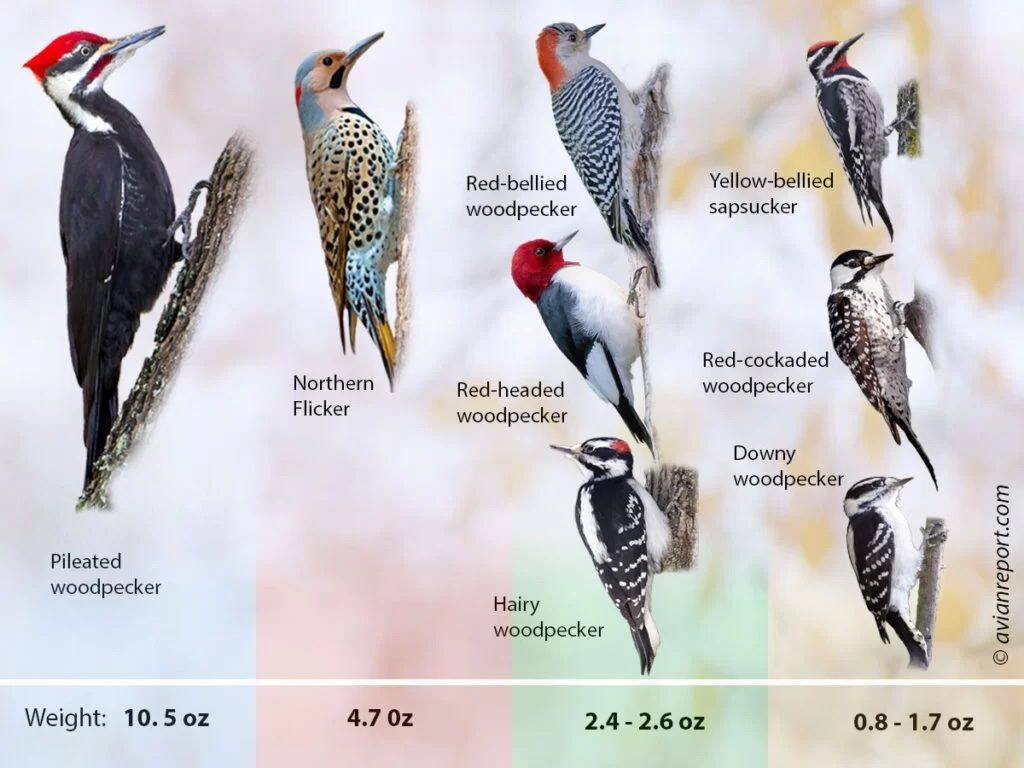

In Florida, most woodpeckers have a combination of black, white, and red feathers. They are distinguished by patches of red on the backs of their heads. Males have red patches, which are missing in the females except for red-headed woodpeckers where males and females are indistinguishable.
Woodpeckers in Florida have similar breeding habitats. In all species, the male and female excavate a nesting cavity in dead wood, incubate the eggs, and feed the young. The entrance hole varies in size and from round to oval depending on the species. Interestingly, woodpeckers do not build a typical nest inside the cavity but lay the eggs in a bed of wood chips accumulated there during the excavation of the cavity. Depending on the species, a female woodpecker lays from 2 -10 eggs. Both parents incubate the eggs during the day, but males always incubate during the night. The incubation period lasts only between nine and 14 days.
Florida woodpeckers can be divided into 3 separate groups based on the food type and how they obtain it:
- Typical woodpeckers: This includes all woodpeckers except the flickers and sapsuckers. Typical woodpeckers hitch along trunks and branches where they peel off bark or drill into the wood for insects, beetles, or ant larvae.
- Flickers: In Florida, this group includes only the northern flicker. Flickers differ from other woodpeckers in that they are mostly ground woodpeckers. Flickers have specialized in a diet consisting of mostly ants and ant larvae. Instead of pecking on wood, flickers peck on the ground at ant nests digging for the nutritious larvae found in ant colonies.
- Sapsuckers: This includes only the yellow-bellied sapsucker which has specialized in a diet based on sap from trees. They drill rows of sap wells and consume not only the sap flowing out of the wells but also the insects attracted and trapped in the sap well. Yellow-bellied sapsuckers also peel off bark to find insects and supplement their diet with berries.
Woodpeckers are known for their distinctive drumming sounds. Their drumming serves crucial purposes, such as attracting mates and establishing a territory. Drumming in woodpeckers is a distinct and often loud sound created by rapidly striking their bills against a resonant surface (sometimes up to 30 or more beats per second). Drumming serves a communicative purpose unlike their other sounds which are used for more immediate interactions. Drumming serves as a way to attract potential mates during the breeding season, much like a bird song. It’s also used to announce their presence and establish territorial boundaries, warning off rivals. Unlike the songs of many songbirds, which are primarily produced by males, both male and female woodpeckers engage in drumming.
Woodpeckers primarily drum on trees to attract mates and defend territories. They seek resonant surfaces to amplify their calls. (That’s why you’ll sometimes hear them drumming on street signs or house gutters.) Houses, with their potential for resonance and insect infestations, can inadvertently become drumming sites.
Source: Avianreports.com