



“A wonderful bird is the pelican,
His bill can hold more than his belly can.
He can hold in his beak
Enough food for a week!
But I’ll be darned if I know how the hellican.”
Remember that old limerick? It was written by American journalist Dixon Lanier Merritt in 1910 and published in his 1913 newspaper column.
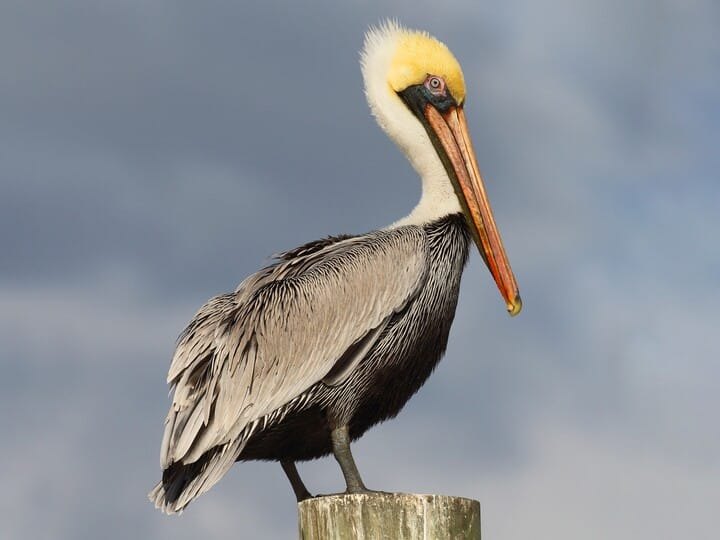
Whether diving at a 90-degree angle to snatch up fish, coasting over the water with its tremendous 6–7-foot wings outspread, or plodding onshore to steal the day’s catch from local fishers, the Brown Pelican is one versatile seabird. The brown pelican can fly up to 48 kph (30 mph).
Fossil records date the species’ evolution back at least 30 million years— but just a few decades ago, Brown Pelicans were on the brink of extinction. Conservationists and biologists have worked hard to help them rebound, and today’s much larger population is evidence of their success.
Contrary to common lore, Brown Pelicans do not store fish in their beaks (or to be technical, in their gular pouches). As soon as a pelican catches a fish and drains the water from its pouch—which can expand like a balloon to hold up to three gallons of water (several times more than his belly can)—it swallows its meal right down.
Brown Pelicans eat mostly fish, which they spot from up to 70 feet in the air before diving dramatically bill-first into the water. The force of the birds’ impact stuns small fish, enabling Brown Pelicans to scoop them up in their throat pouches. In shallow water or when fish school near the surface, a pelican may feed by simply floating on the surface of the water and seizing prey with its bill. Brown Pelicans also steal food from other seabirds, pilfer bait fish or guts at piers, and eat invertebrates such as prawns.
From 1970 until 2009, the Brown Pelican was listed as an endangered species. Like many birds, pelicans fell victim to DDT, a pesticide that caused birds to produce eggshells so thin they broke under the weight of their parents. Today, Brown Pelicans number an estimated 370,000 and are no longer considered a species of conservation concern.
Brown pelicans are extremely social animals and prefer to nest in colonies called rookeries. These are typically found on remote islands, where the birds are free from predators. A rookery can host thousands of pelicans, all looking for the best nesting spots and mates. A male pelican will choose a nesting site and perch there defending his spot, sometimes for several weeks, before a female decides to mate with him. But once a match is set, the pair remains monogamous—for a season, that is.
Brown Pelicans are parenting pros. Male and female Brown Pelicans work together to build their nest: The male delivers sticks while the female handles construction. The female usually lays three white eggs, which both parents take turns incubating, mostly using their feet — essentially standing on the eggs to shelter them from cold air or hot sun. Both parents bring fish back to the young birds in their throat pouches and regurgitate the food, which the chicks snap up.
Brown Pelicans like to feed close to shore, making them particularly susceptible to oil spills. In April 2010, just a few months after the Brown Pelican was removed from the endangered species list, the BP oil spill unleashed 134 million gallons of oil into prime pelican breeding sites off the coast of Louisiana. Researchers estimate that the United States lost 10 percent of its Brown Pelican population as a result.
Notes:
Florida Fish and Wildlife Conservation Commission
United Parks and Resorts
American Bird Conservancy
Audubon