


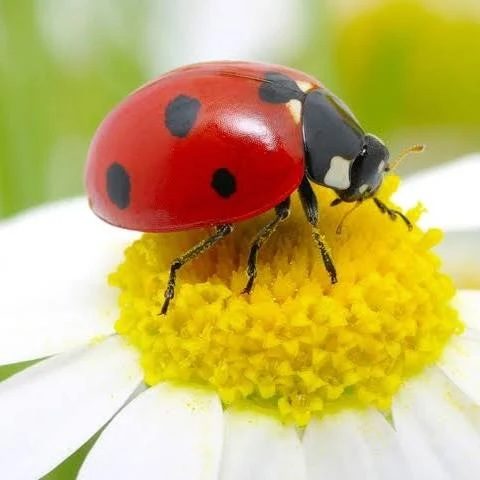

Ladybug, ladybug, fly away home,
Your house is on fire and your children are gone,
All except one, and her name is Ann,
And she hid under the baking pan.
This rather morbid nursery rhyme is one we probably all learned in our childhoods. Actually, it has a rather interesting history. The rhyme is believed to originate from 16th-century Britain when farmers would burn their hop fields after the harvest to clear the land and kill off pests. The burning also inadvertently claimed the lives of the ladybug larvae and pupae left behind. The farmers’ chanting of the rhyme was intended as a warning to the ladybugs. Today, it remains a beloved childhood verse, passed down through generations.
An old European legend says that the name “ladybug” started when farmers prayed to the Virgin Mary for help when masses of aphids were destroying their crops. Large numbers of red, spotted beetles appeared and devoured the aphids. Grateful for their assistance, the farmers called the insects “Our Lady’s beetles”, so the name has remained. There are over 500 types of ladybugs identified in the US and more than 4000 worldwide. NASA even sent a few ladybugs into space with aphids to see how aphids would escape in zero gravity.
As just noted, ladybugs actually aren’t bugs at all but beetles. These much-loved critters are also known as lady beetles or ladybird beetles. Like all beetles, they have two sets of wings. The hardened, often brightly colored outer wings are called elytra, which protect the delicate, transparent flight wings underneath. They come in many different colors and patterns, but the most familiar in North America is the seven-spotted ladybug, with its shiny, red-and-black body. In many cultures, ladybugs are considered good luck.
Most people like ladybugs because they are pretty, graceful, and harmless to humans. But farmers love them because they feed on soft-bodied, sap-sucking garden pests like aphids, scale insects, and mites. A single ladybug can consume roughly 50 aphids a day and up to 5,000 in its lifetime! Most ladybugs have oval, dome-shaped bodies with six short legs. Depending on the species, they can have spots, stripes, or no markings at all. Seven-spotted ladybugs are red or orange with three spots on each side and one in the middle. They have a black head with white patches on either side.
Ladybugs are colorful for a reason. Their markings tell predators: “Eat something else! I taste terrible.” When threatened, the bugs will secrete an oily, foul-tasting fluid from joints in their legs. They may also play dead. Birds are ladybugs’ main predators, but they also fall victim to frogs, wasps, spiders, and dragonflies. Ladybugs lay their eggs in clusters or rows on the underside of a leaf, usually where aphids have gathered. Larvae, which vary in shape and color based on species, emerge in a few days. Seven-spotted ladybug larvae are long, black, and spiky-looking with orange or yellow spots. Some say they look like tiny alligators. Larvae grow quickly and shed their skin several times. When they reach full size, they attach to a leaf by their tail, and a pupa is formed. Within a week or two, the pupa becomes an adult ladybug.
Ladybugs are happy in many different habitats, including grasslands, forests, cities, suburbs, and along rivers. Seven-spotted ladybugs are native to Europe but were brought to North America in the mid-1900s to control aphid populations. Ladybugs are most active from spring until fall. When the weather turns cold, they look for a warm, secluded place to hibernate, such as in rotting logs, under rocks, or even inside houses. These hibernating colonies can contain thousands of ladybugs.