


THE ROAD AHEAD: ESTERO TRAFFIC BRIEFING NOISE ON INTERSTATE 75 EXPANSION A CONCERN
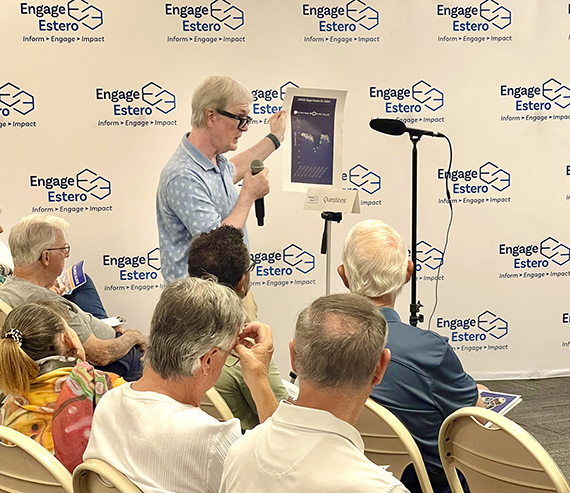
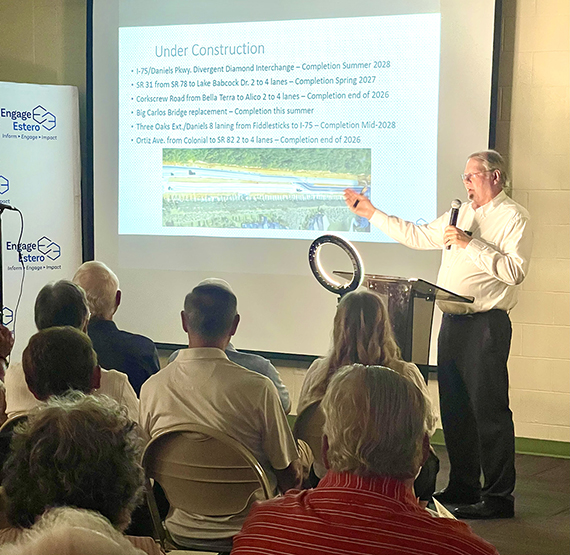
A large turnout of 130 Estero area residents identified their most important road and traffic issues at an April 17th Engage Estero Community Meeting. Don Scott, AICP, Executive Director of Lee County’s Metropolitan Planning Office addressed the residents and informed them of many projects in the works.
He also talked about why developments are outpacing road infrastructure. He discussed the funding options, what seemed feasible and what are the ramifications. e.g. Increasing sales tax, impact fees, gas tax.
A question and answer session gave residents a chance to share their various concerns.
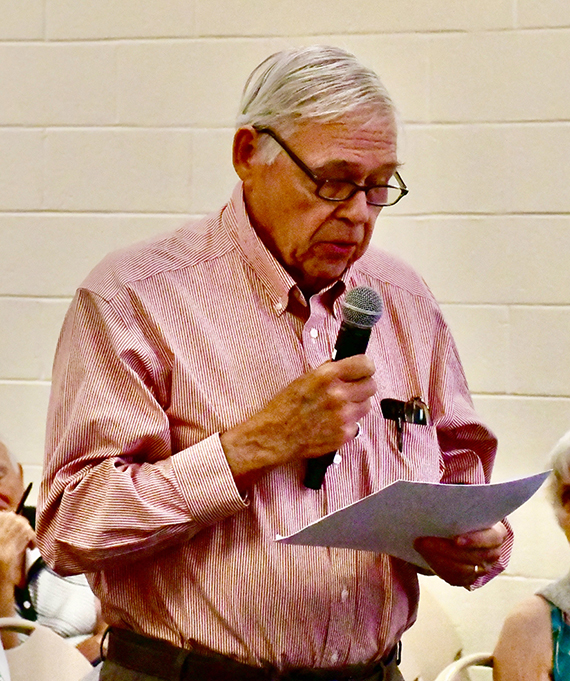
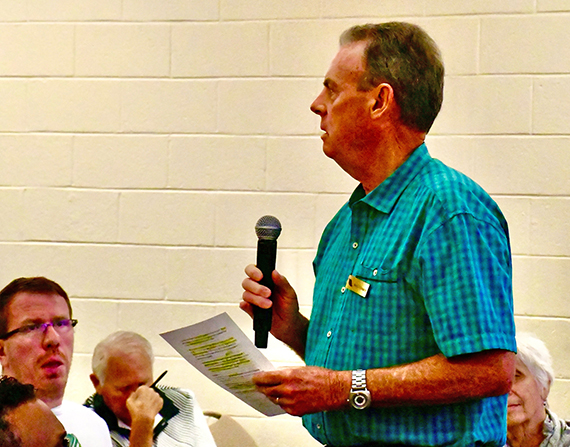
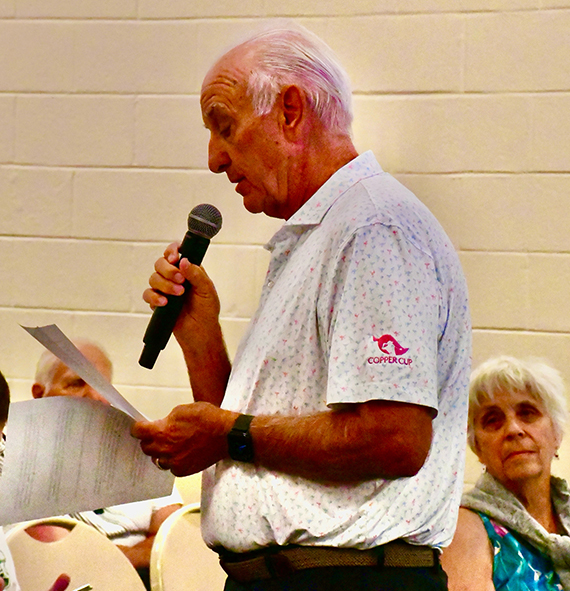
The biggest issue seemed to be about the expansion of Interstate 75 from six lanes to 10 lanes. Many residents came prepared with detailed questions and statements regarding the issue of noise and the status of detailed studies being considered by FDOT.
Brian Bollas from the FDOT regional office was also scheduled to speak on the latest I-75 expansion to 10 lanes from 6 lanes, but regrettably had to cancel his attendance one day before the event “due to unforeseen circumstances.” Brian Bollas said FDOT “will be happy to discuss our projects at a future date in the Fall.”
“We take public comments very seriously and scheduling issues does not imply we do not consider public comments important. We welcome and address all comments and until such time when we are available to attend the group’s meeting, the public can submit comments, questions, and concerns via our project website.”
A video of the event is available on Engage Estero website http://www.EsteroToday.com/Apr2026 along with a more detailed article. WINK News also attended the event and taped many of the speakers who had questions. Engage Estero indicated at the meeting their plans to provide a copy of the video to FDOT for their review.
Several speakers from CopperLeaf referenced the need for correct noise abatement and asked that FDOT at least hear their concerns. They were disappointed that FDOT did not attend the meeting.
FGCU’S STUDENTS WRITE ARTICLES FOR ENGAGE ESTERO
Who says writing assignments have to be boring? This year Engage Estero teamed up with Professor Barbara Wright’s composition class at Florida Gulf Coast University (FGCU) for a collaboration that brought local history, environmental awareness and traffic issues to life—and the results have been fantastic! Throughout this past school year students crafted insightful papers specifically for Engage Estero’s website, EsteroToday.com. The essay below is a sample of one.
SIGNAL TIMING VS ROAD WIDENING AT EAST CORKSCREW ROAD
By FGCU Students Madara Matrevica and Matthew Oberkehr
Introduction
In recent years, East Corkscrew Road has become a major commuter conduit due to housing development, easy access to Interstate 75, and a lack of alternative east-west roads. The once quiet, local connector road, is now experiencing rapid growth regarding new communities and drivers. However, this increase in traffic has raised concerns among residents about potential tradeoffs, including travel times, safety, and quality of life in the Estero community.
What’s the Evidence?
The East Corkscrew Road corridor is experiencing massive development and growth in population. It is estimated to reach approximately 60,000-65,000 people during the next 10-15 years.
The increase has been mainly driven by expansion projects like Verdana Village, The Place at Corkscrew, and Wild Blue, just to name a few. Approximately 80% of the Verdana Community, consisting of 2,400 homes, has already been sold. The Place at Corkscrew and Wild Blue are already highly populated and established communities. Altogether, these communities have added around 10,000 new residents to the Estero community over the past five to eight years.
The future promises an even larger expansion and a further increase in population density. The anticipated 6,000-acre Kingston Development is already underway and will offer an additional 10,000 dwelling units. Other plans announced in 2025 include a 4,500-home Corkscrew Grove Village.
What’s at Stake?
While the growth of new communities along East Corkscrew Road brings more housing options, services, and economic activity to Estero, it has also put increasing pressure on the corridor, leading to heavier traffic, longer commute times, and rising safety concerns.
Residents expressed their concerns in a recent public forum in Estero, highlighting the long traffic times just to reach Interstate 75 (Zarcone, 2026). Another source reported problems with signal timing at a Corkscrew Road intersection, where the green light provided only 14 seconds for drivers to turn left (Petras, 2026). For these reasons, local officials have held multiple meetings in recent months to discuss the best short and long-term solutions to the arising congestion issues, such as signal timing and road widening.
What Could Be Done Next?
Signal Timing
One of the solutions discussed to resolve traffic issues was signal timing. It is one of the easiest strategies to implement for addressing congestion, as it is both immediate and cost-effective. Unlike road widening, which requires years of planning, funding, and construction, traffic signals can be adjusted from afar to better match changing traffic patterns.
A 2017 Village of Estero traffic report recommended optimizing signal timing by re-timing and adjusting cycle lengths (Horn, 2017). In some intersections, changing the timing of the red and green signals was estimated to be the only change necessary to ensure smooth traffic. Re-timing was especially promising, as it would account for the busier hours and lanes prone to congestion. Many of the improvements from the 2017 study were implemented, but traffic volumes have increased faster than anticipated, requiring further analysis and solutions.
Officials responded by conducting another Engage Estero Traffic Study in 2024. They determined that the overall efficiency of traffic flow along East Corkscrew Road was relatively steady, with the level of service (LOS) averaging a B to C on an A to F scale (Resto, 2025). These were surprisingly good results, even better than in 2017. However, directional flows varied significantly, causing congestion in some intersections at peak hours. The most concerning spots include Corkscrew Road at Three Oaks Parkway, which had one of the highest numbers of crashes, along with the junctions at Tamiami Trail and Estero Parkway (Bowditch, n.d.). Residents reported that some signals fail to adjust to real-time traffic, causing more delay than necessary.
The study suggested improving signal timing through technologies like adaptive or AI-based traffic systems that use sensors and cameras to detect traffic volume and adjust lights in real time. Such systems would improve both traffic and safety during peak hours by accounting for the changing flow. Nevertheless, signal timing cannot increase the physical capacity of the road. With the projected population growth along East Corkscrew expected to add 28,000 people, traffic light optimization can help regulate the patterns, but it does not address added drivers, which is the primary cause of congestion. It needs to be paired with other upgrades, like additional lanes or roundabouts, to properly deal with increasing population numbers.
Road Widening
An ulterior solution to the ongoing congestion on East Corkscrew Road would be road widening. East Corkscrew Road has undergone significant changes over the past several years as Lee County responds to its increasing population and incoming traffic. Originally a road consisting of two lanes, East Corkscrew was widened in the late 2010s, with key decisions made by the county to expand it to four lanes in areas with high and rapid population growth and infrastructure. These changes were made to make housing more convenient for everyone and provide alternative routes to heavy traffic areas such as Corkscrew and Alico Road. However, congestion on East Corkscrew Road remains a prevalent issue.
Road widening would address multiple important effects caused by congestion, such as delayed emergency response times and traffic jams for residents. More lanes would also address safety concerns because reducing heavy traffic in intersections decreases the likelihood of accidents. However, there are possible downsides to road expansion. They include environmental impacts such as the runoff of contaminated water and the disruption of local habitats, which have been a topic of public discussion, as the water systems involved with East Corkscrew have been heavily affected by rapid expansion (Garcia & Fischer, 2026). Additionally, the cost of widening the road and adding more lanes can dent the local budgets.
Widening the roads and implementing more lanes would allow for faster and more efficient transportation and reduce the risk of an accident occurring on the road, as the project would aim to improve the flow of traffic and overall safety of drivers (Galo, 2025). Second, improving upon targeted intersections such as turn lanes or roundabouts would further secure the safety and efficiency of drivers. Although expensive, the long-term benefits of widening the roads would overall outweigh the cost.
Conclusion
Estero has experienced a significant growth in population over the past few years that will only continue to increase with further development projects. These changes have contributed to more drivers, which in turn, have increased traffic and congestion. The two most promising and prominently discussed solutions are signal timing and road widening. The optimization of signal timing through adaptive or AI-controlled systems would allow for real-time adjustments and address the directional flow variations throughout the day, reducing congestion by considering traffic volume changes. Widening the roads and adding more lanes, though costly, would be worthwhile for the community, as it would secure a safe and efficient ride for all drivers on the road.
Overall, the most effective solution would be to implement both ideas simultaneously, as signal timing only manages the traffic flow itself, while road widening addresses the underlying cause: population increase and a lack of road capacity. By understanding the impact that the growing population in Estero has on traffic, residents can make better decisions on the future of transportation and advocate for solutions.
References
Bowditch, A. (n.d.). 2024 Traffic Study Results. Engage Estero. https://esterotoday.com/mar2025summary/
Engage Estero, Inc. (2025). The unseen water map: Wetlands, drainage, storm water systems, flood concerns. https://esterotoday.com/the-unseen-water-map-wetlands-drainage-storm-water-systems-flood-concerns/
Galo, A. (2025, August 26). Where is Lee County at with the Corkscrew widening project? WINK News. https://www.winknews.com/news/lee/where-is-lee-county-at-with-the-corkscrew-widening-project/article_f73e69a9-694c-4582-ab0a-a122212a7fb6.html
Petras, T. (2026, March 23). Estero drivers frustrated by 14second green light at Corkscrew Road intersection. WINK News. https://www.winknews.com/estero-drivers-frustrated-by-14-second-green-light-at-corkscrew-road-intersection/article_88eebc6a-9e41-4895-907d-732dc1fcc9bb.html
Pinero Resto, L. (2025, April 4). Residents learn highlights from the recent Estero traffic study. WGCU. https://www.wgcu.org/top-story/2025-04-04/residents-learn-highlights-from-the-recent-estero-traffic-study?utm_source=chatgpt.com
Zarcone, H. (2026, March 17). Estero community forum highlights traffic growth and solutions. WINK News. https://www.winknews.com/news/lee/estero-community-forum-highlights-traffic-growth-and-solutions/article_b2e37a3a-7f90-4bb5-8b84-17c031240a4c.html