


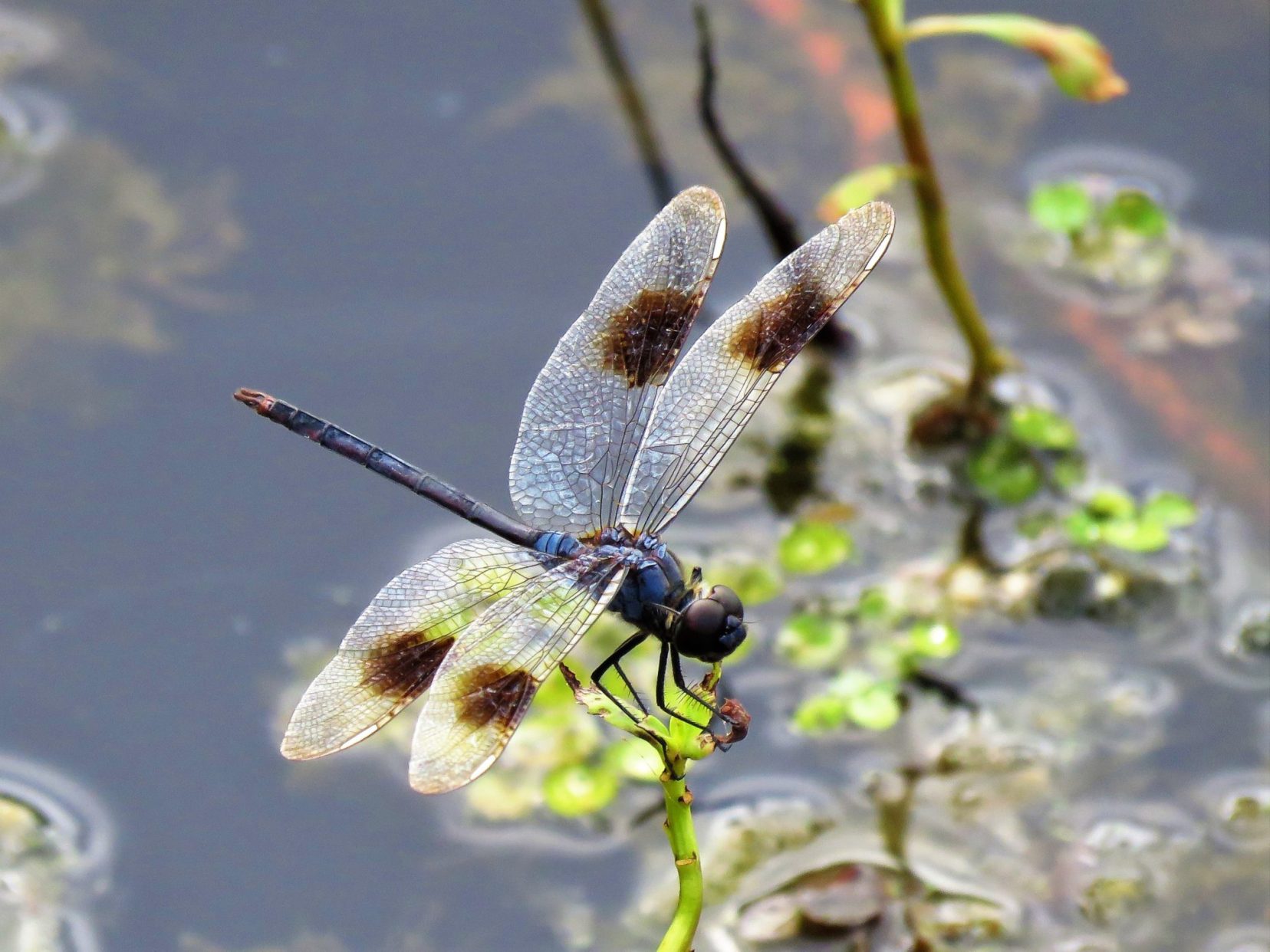
DRAGONFLY

Dragonflies can be mistaken for the closely related damselflies, which are similar in body plan, though usually lighter in build. The dragonfly belongs to a large insect order called the Odonata. Within this taxonomic order are two suborders: the Anisoptera (dragonflies) and Zygoptera (damselflies). Damselflies differ from dragonflies in that they are less robust and hold their wings folded over their backs instead of out to the side like dragonflies. Dragonflies are agile fliers, while damselflies have a weaker, fluttery flight. In terms of physical size, dragonfly bodies are thicker and chunky with a length of roughly 2-inches (though they can be smaller). The damselfly is roughly 1-1.5 inches in length with an extremely thin, twig-like body.
Odonates represent one of the most primitive living insect orders. Their earliest fossils date back 250 million years. The probable ancestors of Odonata, the order Protonata, lived more than 300 million years ago. Some had wingspans greater than two feet.
One interesting theory about the origin of the name dragonfly can be found in a book written by Eden Emanuel Sarot in 1958 entitled Folklore of the Dragonfly: A Linguistic Approach. He theorized that the name dragonfly came about because of an ancient Romanian Folktale in which the Devil turned a beautiful horse ridden by St. George (of St. George and the dragon fame) into a giant, flying insect. The Romanian names that people supposedly used to refer to this giant insect meant ‘St. George’s Horse’ or, more commonly, ‘Devil’s Horse’ when translated into English. The Romanian word used translates to both dragon and devil, so over time, dragonfly eventually became the English name.
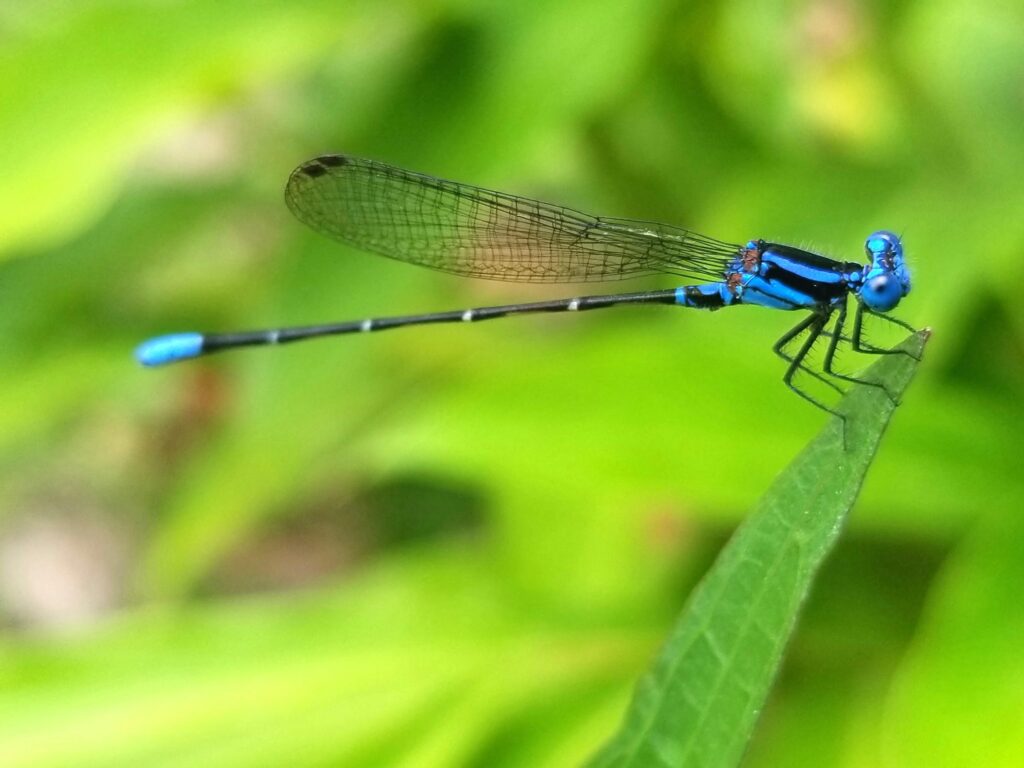
Dragonflies are fast, agile fliers, reaching speeds of up to 30 miles per hour and sometimes migrating across seas and oceans, and often live near water. This speed helps them avoid predators like birds and frogs and enables them to capture their own food. These amazing insects can move in any direction and change direction suddenly. In flight, the adult dragonfly can propel itself in six directions: upward, downward, forward, backward, to left and to right. Their wings are powered directly which is unusual in the insect world, and they have four distinct power patterns for taking flight ranging from aircraft-style lift to a vortex system.
Despite their fierce name, dragonflies do not sting or bite people. Their huge compound eyes help them see prey, which they catch in mid-air, and their powerful jaws allow them to clamp onto their victims until they are devoured. An adult dragonfly’s compound eyes have nearly 24,000 individual functioning units. Dragonfly eyes are large and close together, so they occupy most of the head. Damselflies have large eyes as well, but there is a noticeable gap between their eyes.
Often called the mosquito hawk, the dragonfly is a voracious predator in both of its life stages as an aquatic nymph and an adult. Water is fundamental to the dragonfly’s life cycle. After mating, it lays its eggs near or in streams, lakes, ponds, canals, ditches, marshes, and other wetlands. Eggs can be killed by mold and eaten by aquatic mites. Those that survive hatch into aquatic nymphs in about 10 days, though the time span varies from five days to several months specific to each species. Nymphs eat many species of invertebrates and small fish. In turn, nymphs are eaten by fish, frogs, turtles, and birds.
Dragonflies live on every continent except Antarctica in contrast to the damselflies (Zygoptera), which tend to have restricted distributions though both are present in Southwest Florida.
Notes:
Toti.com
NatureCoaster.com
Wikipedia.com
FriendsofKenilworthaquaticgardens.com