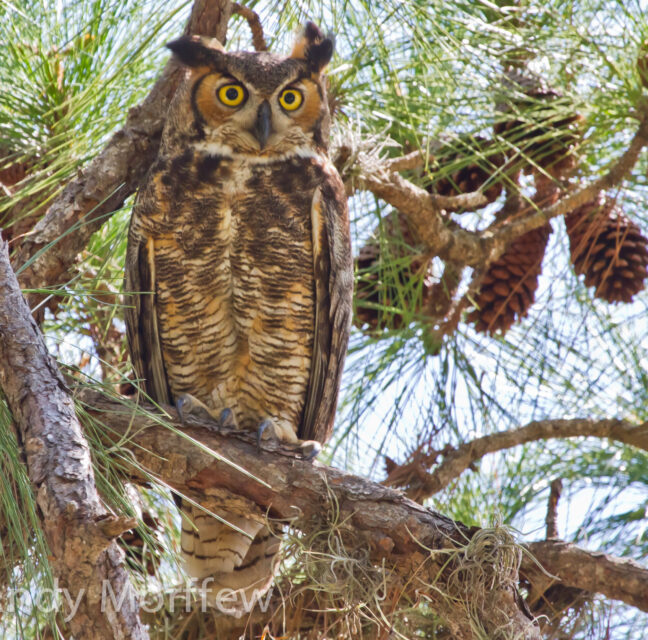


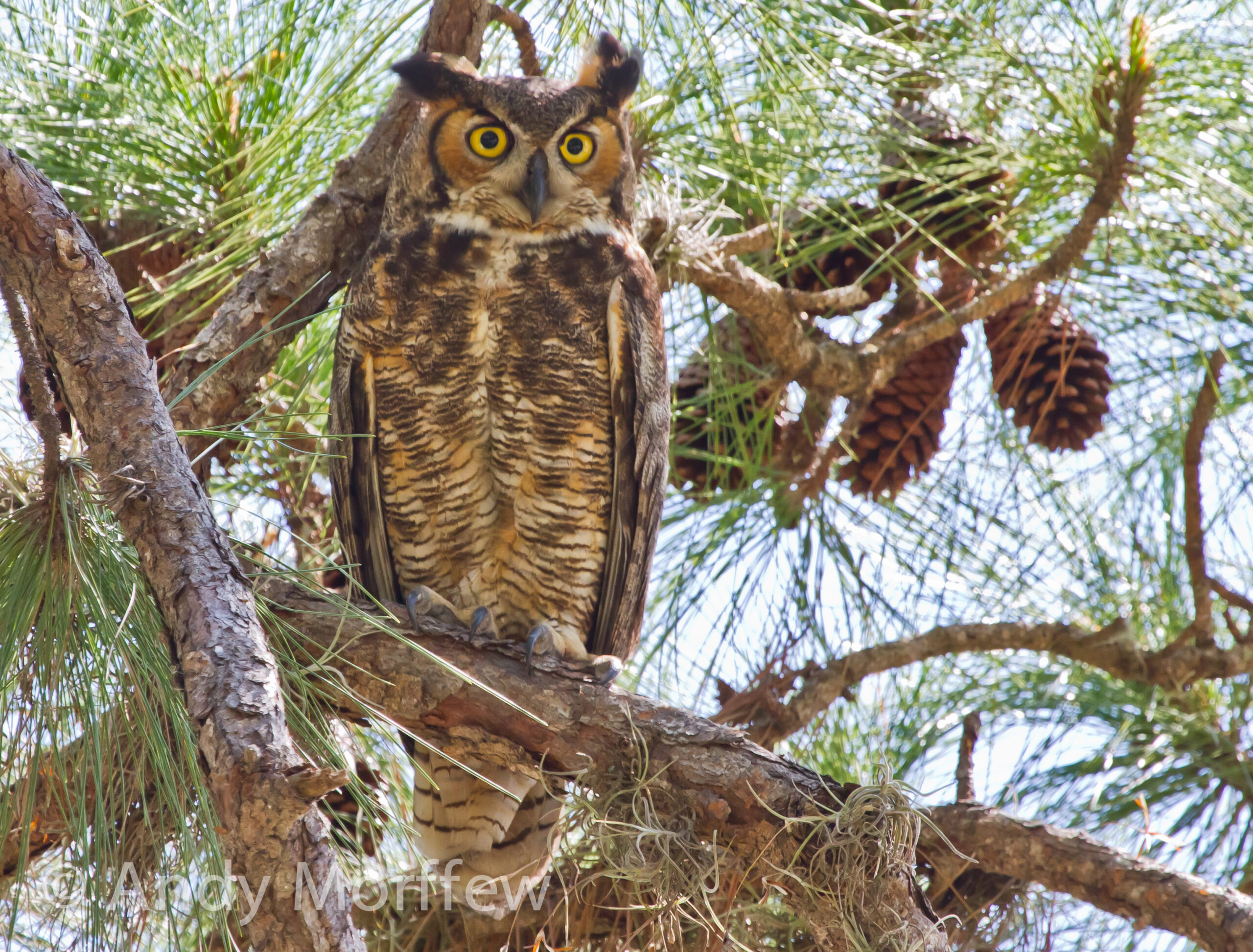
GREAT HORNED OWL
Florida is home to five resident owl species which are fairly easy to identify, but they can be confused. Most people will need to identify owls by sound, not by image or in-person sightings, which makes owl identification tricky! When considering owls’ calls, they can be easily identified with a bit of practice. Keep in mind that every species produces a wide range of calls and sounds.
There are three species of “large” owls in Florida – Barred, Barn, and Great Horned. If you get a chance to see them, you’ll notice they are all about the size of a football, or larger.
GREAT HORNED OWL
When you read a storybook about owls, chances are the illustrated owl is a great horned owl. They prefer wooded areas but live in many habitats across Florida. They are comfortable in park settings and rural areas. Great horned owls have the most diverse diet of any North American raptor, eating things like rodents, insects, and other birds. Great horned owls are usually 18–25 inches tall, have tall ear tufts, and large yellow eyes. Their size, ear tufts, and eyes make them easily recognizable when seen during daylight hours.
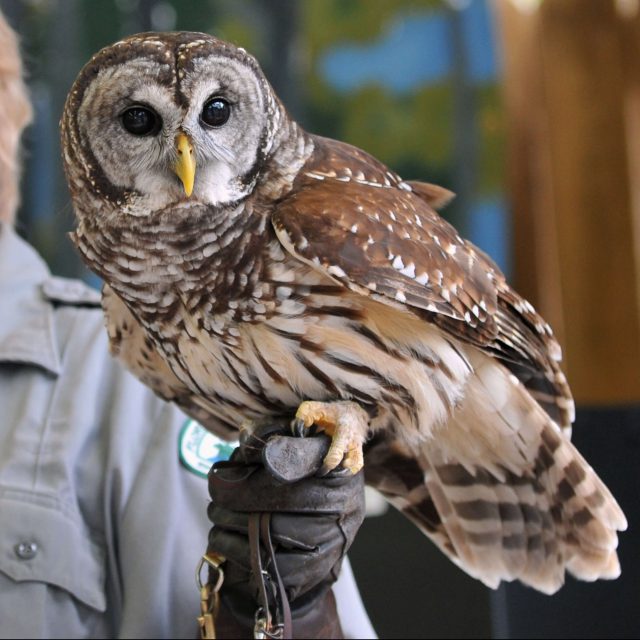
BARRED OWL
The barred owl is another very common species in Florida. They are territorial year-round, more aggressively so during nesting season. They are currently thought to mate for life and usually raise one brood of up to five young per year. They prefer areas with large trees, usually near water. Barred owls will use trees with existing nesting cavities but also take well to nest boxes. They prefer cavities 20-40 feet high, in large trees. They have been known to take over platform nests built by hawks as well.
Barred owls, at maturity, are 16-24 inches in height. They have a mottled brown and white pattern to their feathers with brown “bars” across their chest. They do not have ear tufts, as the Great Horned owls do, and they have yellow beaks. From a distance, observers will notice the large size of the barred owl, the brownish coloration, and the absence of ear tufts which makes them fairly easy to identify compared to a great horned owl. Additionally, barred owls have large dark eyes.
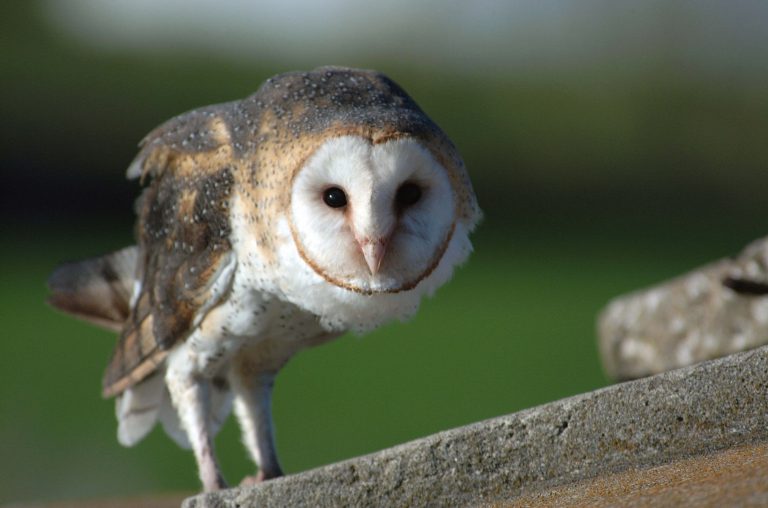
BARN OWL
Barn Owls live in open habitats across most of the lower 48 United States but is the least common species in Florida. These include grasslands, deserts, marshes, agricultural fields, strips of forest, woodlots, ranchlands, brushy fields, suburbs, and cities. They nest in tree cavities, caves, and in buildings (often barns). The female makes a simple nest of her own regurgitated pellets, shredded with her feet, and arranged into a cup to hold the eggs. Unlike most birds, barn owls are thought to use their nesting cavity for roosting year-round.
They usually stand 12-16 inches tall with a largely white, rounded heart or satellite dish-shaped face. They have mottled tan and grey feathers on their back and wings with mostly white feathers across their chest and legs. They are found throughout Florida and roost in large, messy nests, in tall trees. The female is larger than the male, but the male has a larger and deeper voice box.
The call is an eerie shriek, which may have led to many of the folk tales, superstitions, and urban legends which focus on this species.
In addition to the three large species, there are two “small” species of owls in Florida. The Eastern Screech Owl and Burrowing Owl more than make up for their small stature with personality.
EASTERN SCREECH OWL
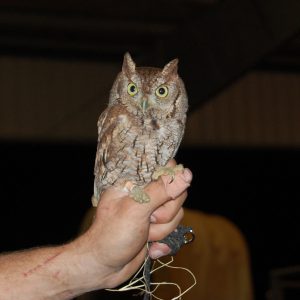
The eastern screech owl is Florida’s smallest owl. Standing only 6-9 inches tall at maturity, these little owls are commonly seen in Florida’s residential areas. They are usually brown or reddish-brown in color, have bright yellow eyes, and ear tufts. For their size, they have a large head compared to their body. They have excellent camouflage against Florida’s native tree species.
Screech owls, or “Screechies,” as some Floridians call them, readily adopt nest boxes but naturally look for small tree cavities for their roosting cavities. Male screech owls are very territorial and may maintain several cavity roosts within their small territory. Within their cavity roosts, females do not build a nest. They use some wood chips or debris left from a previous nest to lay their eggs in. While nesting, these little owls are easily observed when the male brings food to the nest or when the female watches the surrounding area by sticking her head out of the cavity entrance.
BURROWING OWL
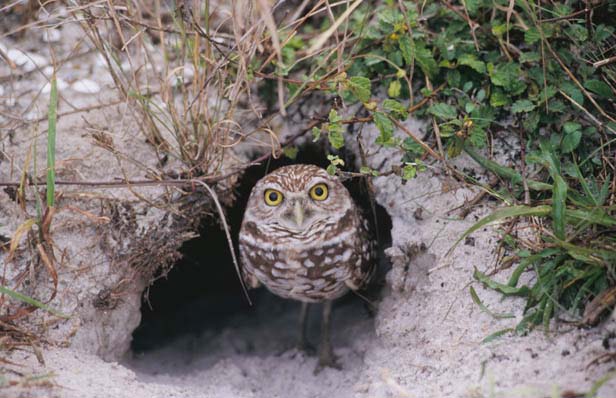
The burrowing owl is Florida’s only state-designated Threatened Species of owl. They usually stand 7-10 inches tall and, except in size, are most similar in appearance to a barred owl. The burrowing owl has mottled brown and buff coloration and does not have ear tufts. They have long legs, short tails, and are full of personality.
Burrowing owls live in areas with wide-open spaces and little vegetation. They often live in rangeland areas, like cattle pastures, but can also live in urban areas with open field-like habitats like golf courses, recreational sports fields, and vacant lots in residential areas. Unlike most species of owls in Florida, the burrowing owl spends most of its time on the ground or in its burrow.
Install the Merlin Bird ID app on your phone to listen to the sounds of these and other birds.
Sources:
• https://myfwc.com/wildlifehabitats/profiles/birds/owls/
• https://www.allaboutbirds.org/guide/browse/shape/Owls • https://youtu.be/XhTFTNucDcw