


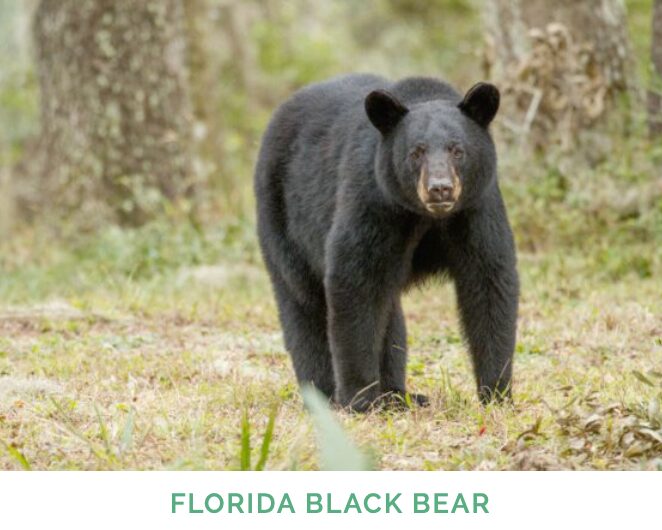

With all the current discussion about hunting black bears, I thought it might be a good time to know a few things about them.
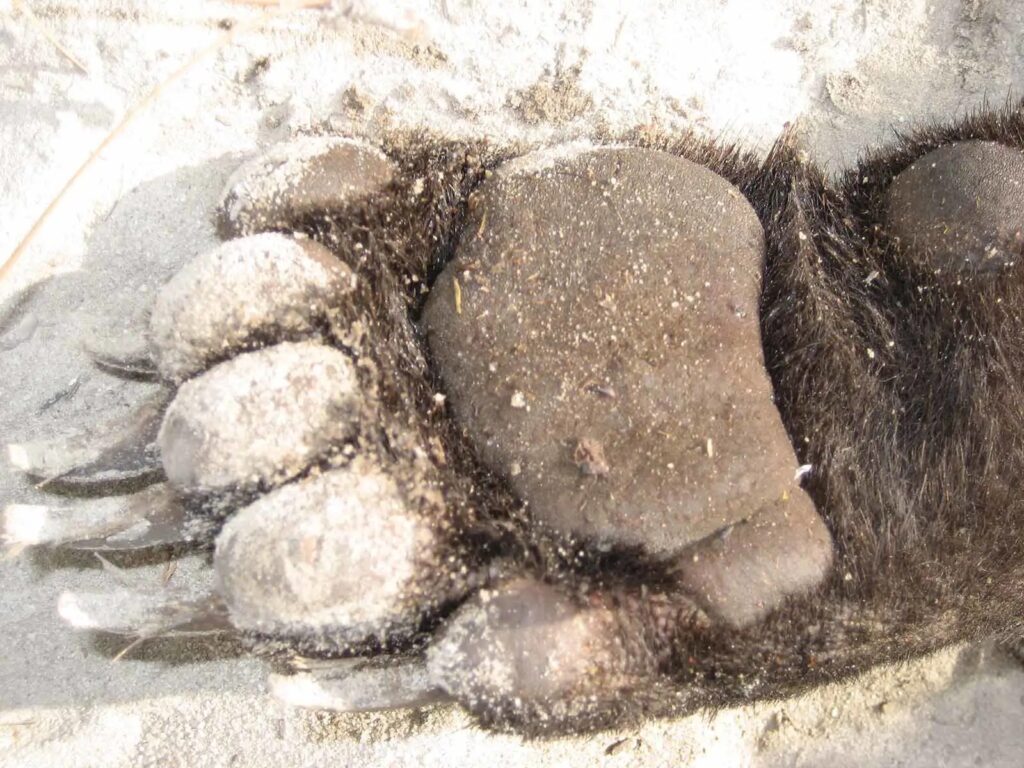
Black bears originated in North America and have been here at least 1.5 million years. There are currently estimated to be about 4,000 black bears in Florida. Like all members of the bear family, black bears are large, powerful mammals with small eyes, rounded ears, short tails, 5-toed feet, and large canine teeth. Black bears walk flat-footed with all 5 toes on the ground in a pacing stride, where both legs on the same side move together. While they may look slow because of their shuffling gait, black bears can sprint at up to 35 miles an hour! With their stout, heavily curved claws, black bears climb trees very well. These claws are non-retractable and can be easily seen in their tracks.
A Florida black bear’s diet varies, but usually consists of 73% plants, 22% insects, and 5% animal matter. The vegetative part of their diet is made up of acorns, hickory and other nuts as well as saw palmetto, holly, and pokeweed berries. They also feed on colonial insects such as wasps, bees, termites, and ants. The meat portion of their diet is things that are dead (carrion) or play dead (e.g. armadillos, opossums) and are mostly obtained from scavenging. During the summer months, bears eat about 5,000 calories a day or the equivalent of two large cheese pizzas. Prior to the winter season they take in about 20,000 calories a day or the equivalent of 8½ large cheese pizzas.
Bear cubs (usually two) are born in late January to mid-February. They weigh about 12 ounces at birth and are partially furred but blind and toothless. They rapidly grow to six to eight pounds within ten weeks.
Black bears are shy and reclusive. They use various means to express their emotions including vocalizations, body language, and scent marking. They are mainly solitary, except when females have dependent cubs or during mating season. Although they are solitary mammals, they are not territorial and typically do not defend their range but will defend a food source from other bears. Black bears have good eyesight (especially at close range), acute hearing and an excellent sense of smell that is believed to be the best of any land mammal.
A bear is always looking for food and is not very particular as to what foods it will eat. In addition, the bear can smell food up to a mile away. A bear’s search for food is the primary cause of conflicts with people. Bears are often attracted to smells of garbage, bee yards, pet foods, barbecue grills, wildlife feeders, and other temptations that bring them closer to human homes, which can result in property damage and safety concerns for both people and bears.
Should you encounter a bear at close range, the Florida Wildlife Commission suggests that you remain standing, back away slowly, and speak to the bear in a calm, assertive manner. Do not turn your back or play dead. Do not run, as this can trigger the chase instinct in some animals, including bears. Do not make any sudden or abrupt movements. Avoid direct eye contact, as some may view this as a threat.
• If a bear stands on its hind legs, this is not aggressive behavior. It is trying to see you better to assess whether you are a threat or not.
• If a bear comes towards you, paws the ground, huffs or clacks their jaws, they are showing that they are uncomfortable and are trying to get you to give them space. Continue talking and backing away slowly with your arms raised to make yourself look bigger. In the unlikely event that a bear charges and makes contact with you, fight back!
• If you are in your yard, make sure you are in a safe area and the bear has an escape route. Make noise or bang pots and pans to scare the bear away.
Remember that bears are wild animals and while they are generally shy and want to avoid humans, they have the ability to seriously harm humans. Give them plenty of space; if their behavior changes because you are there, then you are too close. While not usually aggressive, they are strong and can react defensively if provoked, especially when protecting cubs or food. Studies show they avoid confrontation 90% of the time, often giving warning signs like jaw popping or bluff charges before any attack. Bear attacks on humans are extremely rare.
Notes: Florida Fish and Wildlife Conservation Commission, Florida Wildlife Federation, Wikipedia