



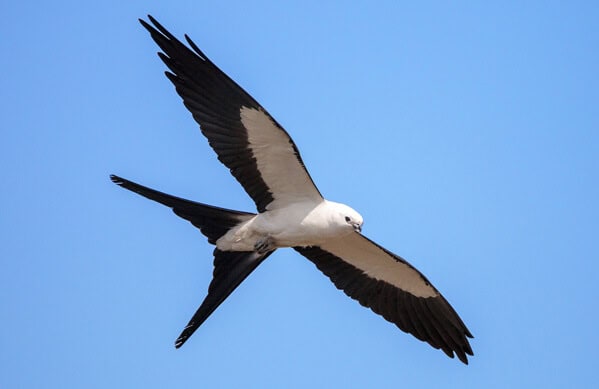
One of the more recognizable birds of our spring skies is the Swallow-tailed Kite. These “spring breakers” of the bird world typically arrive here in March. The Swallow-tailed- Kite is a raptor, unmistakable in flight with its long, pointed wings, deeply forked tail, and contrasting black-and-white plumage. This largest of American kites is a graceful, buoyant flier, so lightweight and maneuverable that it can capture a dragonfly mid-air or pluck a lizard from its treetop hideout – all without a single wing beat.
The Swallow-tailed Kite nests and breeds in our area during the spring and summer and migrates back to South America for the winter. From its bill to the tip of its forked tail, the Swallow-tailed Kite measures almost two feet long, with a wingspan of over four feet. Its white body and black wings and distinctive tail make it easy to identify. This bird is usually seen in flight, often high over the trees, and is often heard. One of its calls is a high-pitched, whistled klee-klee-klee.
Swallow-tailed-Kites primarily eat flying insects such as dragonflies and cicadas, which they capture and consume on the wing. But these predatory acrobats don’t limit themselves to invertebrates. As they cruise the treetops, they also snag snakes, lizards, treefrogs, and even small bird nestlings Swallow-tailed-Kites primarily eat flying insects such as dragonflies and cicadas, which they capture and consume on the wing. and eggs. They even drink on the wing, skimming the water’s surface to collect water, as do swallows.
During courtship Swallow-tailed Kites spend a lot of time diving, chasing, and vocalizing. When ready to nest, they build a shallow cup of twigs, lined with Spanish moss or other soft vegetation. Pairs build their nests high in the crowns of tall trees such as pine, bald cypress, or cottonwood. In addition to towering trees, successful nesting requires nearby open areas where the birds find prey.
Source: https://abcbirds.org/bird/swallow- tailed-kite
primarily eat flying insects such
as dragonflies and cicadas,
which they capture and consume
on the wing.